Showing posts with label suburbia. Show all posts

Saturday, September 8, 2012

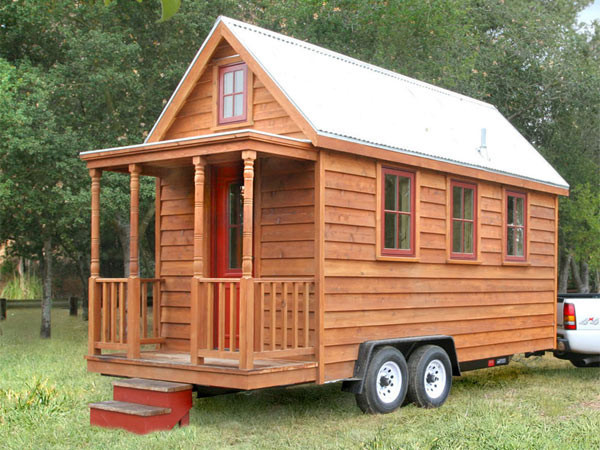
Tiny homes are an elegant solution

Image from http://www.tumbleweedhouses.com/products/tarleton

The world is urbanizing. The U.S. is mostly urbanized (around 80 percent in cities) and many of the modernist ideals have had unintended consequences: spreading uses out has lead to long commute times, traffic congestion and diminished urban settings. The tall towers are just as much to blame as the low-density "sprawl".

There seems to be a consensus amongst the urban quality profession that densification is necessary for cities to grow in an economically sound way.  But how do we densify without creating crap?  Many of the newer apartments are garbage, in my opinion, especially around the fringe. That's not what higher density needs to look like. Amongst the multiple options for creating an interesting - connected - urban environment, tiny houses can play an important role.

Diversity is critical to quality urbanism

Over the decades, we've learned that creating urban environments with blank facades and cookie-cutter houses is boring and lacks something. That something, as Jane Jacobs wrote about, is diversity! It's interesting.  When people walk, they prefer places with other people and interesting things to look at. Not a highway.

A walk is much more pleasant in an area with sidewalks, trees, birds, squirrels, buildings, architectural features, vendors, street performance and human beings than one with highways and exchanges. Diversity is the difference.  A highway exchange could be very interesting with more diversity.  Imagine a European style village built around an exchange - houses, shops, cobble-stone. I think the second would be more interesting. Diversity is a crucial ingredient to quality urbanism.

Tiny houses multiply diversity

One thing about tiny houses is that they increase diversity.  It's interesting to look at a tiny house.  Imagine you're walking down the street and you see a tiny house. You'd look at it. I know I would.  They're interesting.  They're often built at a much higher quality than larger homes. They're pleasant. They add to diversity.

This diversity effect, also, multiplies.  Suddenly, the proud owners of these tiny homes have extra cash. They are no longer tied down with a mortgage, maintenance and insurance. They now have money to spend on a diversity of goods and lifestyle opportunities (like travel). This multiplies the diversity effect beyond just the built, interesting, urban form. It allows for a diversity of activities. 

Simple, practical solution (except legally) 


As a Masters candidate, I fully understand the burden of debt.  It's really something to know that you'll have to make loan payments equal to half the price of a mortgage for 10 years.  Plus, I'm told that urban planners should stay "open to experience" and traveling for, at least, the first part of his/her career. I'm sure many other professions offer the same opportunities.  With a tiny house, a person could live in a very high quality place without the burden of high monthly payments.  Freedom!!!!

Tiny homes make sense for many, many reasons and Cities' Codes often require minimum sizes - inside and out. It's told as a case of insurance companies and home-builders pushing large sizes.  And, as a consequence, it's often challenging to find a legal home for your home. Most of them are built on trailers or in rural areas to get around the codes, but imagine a world - for a moment - where you decrease size, increase diversity, increase density, increase quality, increase sustainability and increase savings without sacrifice on location.  Tiny homes are, simply, a part of the solution.


 A Tour of Jay Shafer's Tiny House


Texas Tiny Houses


Tuesday, July 17, 2012

Our Forgotten Connection with Time

Humans have lived for thousands of years and, yet, in our current culture we have forgotten about our connection with time.  People are connected through relationships, space and TIME.  We are connected to the people who came before us and we're connected with those who will come after us. Somehow, we don't seem to acknowledge this time aspect in many decisions that are made with regards to cities and the built environment.

 View from above the National Mall in Washington, DC.
Looking back just over 100 years at one of the most exciting times for urban planning, the City Beautiful movement - which took its inspiration from Haussmann's Paris - worked to create a society with order, civil engagement and social integration through placing world-class public space at the top of the agenda. During this time they created parks, monuments and civic buildings that we still appreciate today.  One of the crowning achievements from this era is the National Mall in Washington, DC, where tens of thousands of citizens meet for civic engagement.  The decisions made at that time are strongly connected with time. What do the decisions made today say about our perceived connection with time? How will our decisions impact future generations?  How do they relate to the past?

I can't tell you the last time a monument of epic proportion was constructed in one of America's cities.  Or in nearly any city to tell you the truth.  Can you think of one? When was the last time that we thought, "this is going to stand for many years and future generations will be connected with us through this space?"

Focus on the "NOW!"

Many of the decisions made, today, are made with weighing the costs and benefits - perhaps over the next 20 years for a major project. Generations in the past had the options to develop land in a way similar to what we call urban sprawl, but they resisted.  They did not spread out because they understood that once this land is developed, it will be very difficult to return it to the previous state. Now, we cover these valuable lands in suburban "snout houses" that probably won't be around in 200 years.

Instead of thinking about our actions as connected to our collective past(s) and to the future, there seems to be this overwhelming consensus idea that our form of society will not be around in 100 years.  That should be a sign.  But, instead, we use it as an excuse to build suburbs, shift public resources to private interests and over-consume nearly every resource on the planet.  I'm not even going to delve into petrol-chemicals.

Typical Suburban "Snout Houses"


Connection to the Past

We have forgotten our past, at least everything before WWII. Native Americans struggle to hold on to their past, but the dominant culture does its best to squash that memory.  African-Americans try to hold on to their past and remember, but the racial histories are something we don't like to discuss.  Is this why we forgotten our past and are so eager to think about the now?  Is it racism?

No matter the cause of our eager desire to quell our connection with past and the importance of history (it was once now!), in denouncing the importance we do ourselves a disservice in our civics and spiritual peace. We must remember the past, embrace it and learn from it. After all, the post-Depression reforms could have helped prevent our current recession if we'd remembered the lessons and not repealed Glass-Steagall during the '90s. In urban planning, as I mention in this blog post, we have a lot to learn from the pre-modern era. 


A Bright Spot

Sign welcoming you to the Absaroka Beartooth Wilderness in Montana
The environmental movement offers a bright spot.  I'm not talking about sustainability and corporate green-washing (though some are good), but the movement that gave rise to the wilderness.  Being from Billings, MT, I appreciate the Beartooth Mountains.  I appreciate their beauty, wonder and natural state.  Getting out there in nature is one of the most calming and clarifying things and individual can do.

When I think about these mountains, and all wilderness areas, I am reminded that they will be preserved for future generations.  As long as the protections aren't watered down, generations 200 years from now will appreciate them in the same was we've been able. We'd do well for ourselves to consider these very long-term aspects as we move forward in our civilization.

It's time to make the connections!


Monday, July 9, 2012

Top Ten Documentaries about Urbanism and Suburbia

I decided to put together a list of some of my favorite urban planning documentaries, after looking around the internet and coming up short.  This is certainly not a comprehensive list and I'm constantly looking for new ones to watch.   Let me know if you have a good one not on here. I hope you find this useful. 


TOP 10 URBAN DOCUMENTARIES

1. The Social Life of Small Urban Spaces 


This is a classic and important documentary covering the research of William H. Whyte on public spaces. His humor mixes with a scientific approach to answering the simple question, "What makes good public spaces work and others not?"

While this is a film from 1980 and of poor technological quality, to today's standards, the content of the film is the highest available.  An absolute top of the list for urban films. Available on Vimeo. I've only found this one suitable preview, though it's not great.


2. Urbanized 


This is a fantastic film that examines cities from the U.S. to Latin America, Europe and beyond.  This documentary highlights many important aspects of urban, beyond New Urbanism, including transportation, public space, community, affordable housing, and the urbanization in developing countries.  It includes interviews with some of the world's top urban thinkers. A must watch for urban enthusiasts!


3. The Pruitt-Igoe Myth


One of the most notorious social housing projects in the U.S., located in St. Louis, was demolished just a few short decades after being touted as "the answer."  Critics often use examples such as Pruitt-Igoe to rail  against modernism and social housing. 

While I - generally - don't like much about the modern movement in architecture or art, this film examines the deeper social reasons for the collapse of this development and the community it once supported.  This film looks into the broader context of St. Louis as a part of the reason for its failure.  Excellent film.   
 

4. e2: Adaptive Reuse in the Netherlands | season II episode 5


While many of the episodes I've seen in the documentary series seem to leave out the human/community aspects (including scale) and I mostly dislike much of what Brad Pitt advocates as "green", I found this particular episode useful despite some of the same old repetition of large scale and repeating facades. 

This short documentary examines a new development in Amsterdam that focuses on human needs and the importance of integrated incomes. One of my favorite sections of the episode comes at the end where they highlight a portion of small lots developed by individual homeowners creating a great mix. It can be seen on Hulu


5. Chávez Ravine: A Los Angeles Story


At number five on the list, this short film tells the story of the vibrant and mostly immigrant community that used to sit where modern-day Dodgers Stadium is located in Los Angeles. This documentary shows the human-side of those who were displaced mega projects during Modern Era and causes one to think about the need to consider equity impacts in urban planning.


6. Sprawling from Grace: The Consequences of Suburbanization

This film encapsulates one of the primary reasons I became interested in urban planning: the environmental impacts of our urban development patterns. Beyond these impacts, the movie looks at the reality of peak oil and the upcoming brick wall our economy faces when the realities of the situation become fully realized. 

Beyond the natural environment, this documentary also considers some of the consequences to the human environment and loss of community that comes from the suburban lifestyle.  While this movie hits homes many of the generally very important concepts, there is little new in the movie, earning it number six on my list.


7. A Convenient Truth: Urban Solutions from Curitiba, Brazil 


From the home of BRT (Bus Rapid Transit) and many other innovative approaches to solving issues facing urban centers around the globe, this movie should almost be number one on my list because it focuses on answers.  However, the lower production quality and lack of a hard-hitting storyline place this at number seven. 

This film demonstrates the importance of innovation in transportation, housing, public space, poverty and the environment. Curitiba is an  example to the world and many cities are following their lead (from Bogotá to New York City).

  8. Radiant City


This is another one of those films that could easily have made the top of my list, but didn't for reasons I'm not going to tell you because it'd give away some of the movie.  

This movie examines the life of suburban families in North America and critiques the lonely and car-dependent lifestyle in a humorous and engaging way.  A very entertaining film that will keep you watching.


9.The End of Suburbia: Oil Depletion and The Collapse of The American Dream


Another film much like Sprawling from Grace.  To be honest with you, this film only makes the list because there are such a limited number of strong urban documentaries out there.  It basically makes the argument that environmental constraints will bring an end to suburbia and stars James Howard Kunstler.

 10. Portlandia


I know, I know ... this isn't a documentary.  But it's so awesome that I had to put it on the list.  I mean, it does take place in an urban center and the town I call home. This is a hilarious series about the cultural idiosyncrasies that are Portland.  I suppose, amongst this list, you could say it is a social critique on the culture of what Richard Florida calls the "Creative Class."  An absolute, five-star, must watch.  On another list, it'd be number one.  


So, what did I miss?  What are your favorites?

Comments about my selection and any that are in your top list and didn't make my selection are welcome.