Over the past 80+ years city form took on an entirely new shape. The modern - Le Corbusier style - towers, office parks, freeways, and separated uses have dominated the landscape. The automobile has slowly usurped other users from the roads.
However, the trajectory of urban design is beginning to move away from auto-oriented developments and back to people-oriented communities. The influence of urbanists like Jan Gehl and the transformation of Northern Europe has made its way into the conversations in cities. In the US, New York City has begun to re-engineer their streets to be more hospitable to human beings and Portland is known for helping launch the concept in the United States. However, cities should do much more and people should take top priority above all else. Here are the top ten reasons why:

1. Community -- cities oriented towards people reallocate the common space towards a public space for people to use. This invites a social atmosphere where you can run into an old friend in the street, or make a new one. Humans are social creatures who like people watching and interacting with their community. Designing cities around people, in every aspect, create conditions best suited for the human condition and provide areas that reinforce community.

2. Equity -- Children. Elderly. Disabled. Poor. Otherwise disenfranchised. Cities are not made for these people. Instead, cities have been designed for (and by) the upper middle-class. Turning the common space into a public space opens the access to everyone! I like to think about how a city does or does not work for someone who can not drive. In regards to just transit, lack of transportation to work is one of the biggest inhibitors to pulling people out of extreme poverty. Cities that work well for the most vulnerable citizens tend to work well for everybody.
 3. Diversity -- Above all, one of the important aspects of a city is diversity and the options that come with the diversity. This includes diversity of people, buildings, organizations, businesses, etc. As an all encompassing term, diversity drives the city. Planning cities for people adds to the diversity in architecture at the ground level, uses in neighborhoods, uses of streets, number of people outside and - generally - more parks (and, thus, more diversity of parks) and trees. Plus, people of all financial backgrounds are more likely to be outside and meet as equals.
4. Health -- People-oriented cities encourage citizens to be outside and walk. I remember my study abroad experience in Maastricht, NL, and we walked or road our bicycles around the city nearly every day. There, the bicycle networks connect between towns and into the countryside. However, one never feels alone. There is a sense of security and destination in the regional design that gets everybody out. The more people are outside, walking or bicycling, the less they are sitting in their cars. Walking is healthy. Additionally, there are fewer wide automobile travel lanes - which are shown to have the highest rates of
fatal crashes for all users. I apologize for the
picture; I couldn't help myself.
fatal crashes for all users. I apologize for the
picture; I couldn't help myself.

5. Economy -- Every year we take all of our accumulated wealth and shovel it as fast as we can to the middle east. On top of that, city coffers all over the country are squeezed. The new infrastructure for suburbia proves expensive to build and maintain. People-centered-cities have fewer miles of road (per person) and less area to cover with safety services. Also, the diversity of people cities diversifies the wealth through more smaller shops. Also, there are fewer car crashes which cost. Portland, for example, found that car crashes cost the regional economy $958 million per year. Plus, homes in people-cities will filter down the economic chain slower.
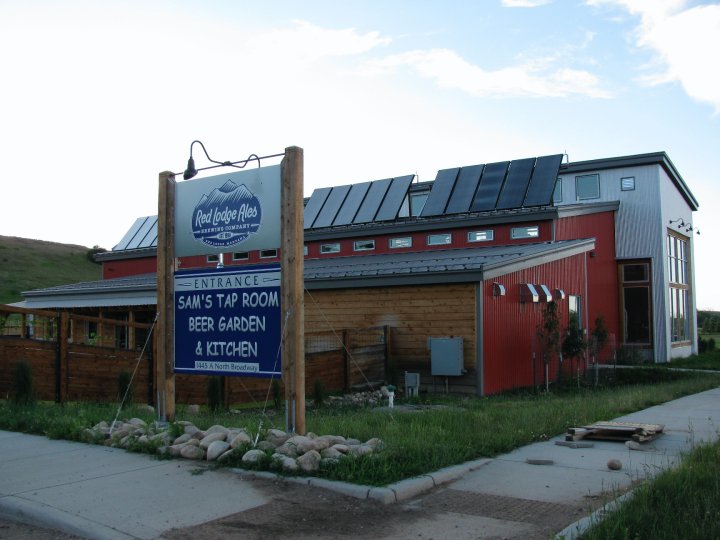
6. Sustainability -- Cities planned around people are inherently sustainable in design. It's possible to build "green" buildings all over the city and still have long distances between buildings and more asphalt than parks. It's a good to build LEED certified buildings but, taken out of the urban context and environment, can lead to negative consequences. For example, Red Lodge Ales Brewing Company (love the beer) - in Montana - moved from a location downtown to the very edge of town to build a "sustainable" LEED certified building. This new location is less sustainable because of the removed walkability. When cities are for
people, they are inherently more sustainable.
people, they are inherently more sustainable.
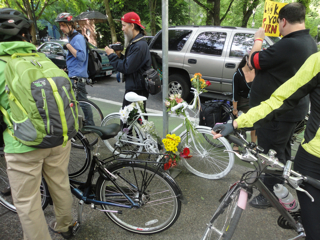
7. Safety -- Each year over 30,000 people are killed in automobile-related crashes in the United States alone. There has been a primary concern about time spent traveling and much less focused on a true increase in safety. Statistics seem to matter when it's someone you know. Ever since the 1920s, we've known that speed is the cause of deaths. However, we build things farther apart and people want to get their quickly. Therefor, we build wider roads and that propagate higher speeds. Building cities around people narrows the space between, increases pedestrian safety and creates safer conditions for motorists. The picture is
of a young woman's ghost bike who was killed
in downtown Portland after being struck by a
truck.
of a young woman's ghost bike who was killed
in downtown Portland after being struck by a
truck.

8. Beauty -- This is entirely subjective, but when people are slowed down they have time to enjoy the architecture. If people are speeding by in their cars, there is no reason to care about the architecture of a building. Think about the Modern architecture era and all of blank walls and places devoid of humanism. Now, think about the older styles -- charm. Additionally, people cities are generally much more compact and spend less money on roads, sewer, etc and have more money for things like parks, statues and beautification.

9. Dignity -- Most people in the United States don't own cars. It's probably higher in other parts of the world. Yet, in an auto-oriented society, those without cars are often looked down upon as second-class citizens. It's degrading waiting long periods of time for a bus and watching cars zoom by. For younger and older citizens, having a people oriented city gives them independence and dignity - thus rising the dignity of the city. Planning for people (not cars) also gives dignity to the human condition and form.

10. Connection -- Cities for people build connections with other people of current, past, and future generations. Due to a high attention required to make cities work for people, they give us more of a chance to connect with the city (sitting, walking, being outside) and encourage an atmosphere of building things worth caring about. Building cities for people builds, something that's been missing, our connectedness with space and time. These cities build things for multiple generations and account for the history of past generations.
11. WE ARE PEOPLE!!!!!
11. WE ARE PEOPLE!!!!!


